

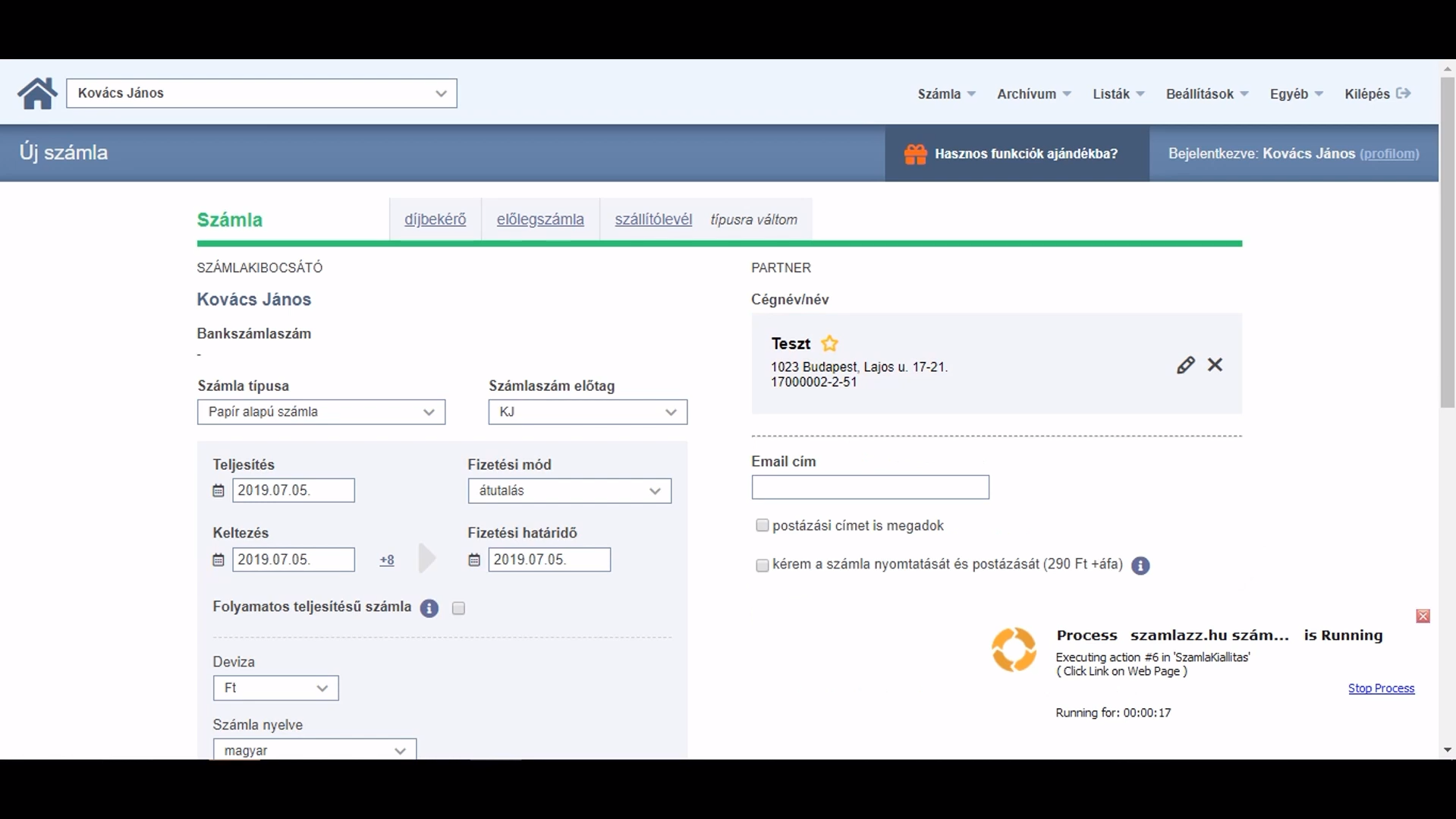
We demonstrate through an accounting process how RPA performs the task.
Repetitive processes exist in virtually every business regardless of industry, so it is worth reviewing current business workflows everywhere. Generally speaking, the highest returns can be achieved in activities such as reporting, accounting, data entry, inventory management, or customer service tasks.
According to a Deloitte study, the investment cost of an RPA (software robot) implementation can be recouped within 12 months. Businesses plan for an average payback period of 9.3 months, while in reality the payback with RPA implementation is 11.5 months. Our own experience shows that this period is lower for simple routine tasks, 4-9 months for both RPA and custom automation solutions.
For fast and efficient development and deployment, we use the Microsoft PowerApps low-code platform, and for RPA (software robot) solutions, we use Microsoft Power Automate/Desktop software.
Our company specializes in custom business software development and process automation. In our projects, we use both custom solutions and market-leading RPA (Robotic Process Automation) systems. Our team examines tasks from both a development and an economic perspective, keeping the client's interests in mind.
Our certified RPA consultants, market-leading automation tools, and the latest applied technologies guarantee that our clients can achieve major efficiency gains through automation. Our consulting services include process assessment and analysis, strategy development, RPA tool selection, and process modeling.


We provide assistance at every stage of process automation, from planning through to ongoing support.
As a first step, we assess business processes, identify automatable tasks, and perform prioritization and make recommendations. After developing the implementation timeline, we present the complete concept.
As a second step, we set up the environment required for development and operation, install the RPA platform to be used, procure the necessary licenses, and assemble the project team.
The third step is the product development and design phase, where we develop features in sprints. During the process, we communicate closely with the client, prepare reports, and continuously test the software being built. When the software robot is ready, thorough testing follows in a test environment before going live.
Once the robot is ready for launch, we hold training sessions and demonstrations for employees or end users to ensure they can properly use the robot. If needed, we build internal competencies through training for maintaining and modifying robots, or even creating new ones.
After handover, we continue to support the RPA project, fine-tune it, and identify and fix bottlenecks and potential errors to ensure it meets the desired quality standards.

Robotic Process Automation (RPA) is the automation of routine business processes using "software robots" that automatically perform tasks. These software robots can replace humans for well-defined, repetitive tasks. Robotic process automation makes extensive use of artificial intelligence to train these robots.
A Low-Code Development Platform (LCDP) is software that allows developers to create applications through graphical user interfaces and configuration instead of traditional computer programming. The platform can focus on designing and developing a specific type of application: for example, databases, business processes, or user interfaces such as web applications. Such platforms can create fully functional applications or may require additional coding in certain situations. Low-code development platforms reduce the amount of traditional manual coding, enabling faster delivery of business applications. LCDPs can also reduce deployment, training, and other initial costs.
This depends on many factors, however simpler tasks can be automated within weeks.
The payback period is naturally faster for larger companies due to economies of scale, but we have also developed software that replaces the daily tasks of 1-2 people, where the investment cost was also quickly recouped. When analyzing processes, we prioritize easily automatable tasks, where the payback is typically 4-12 months, and work hours spent on processes decrease by up to 70%-90%.